Farrer MAHS School Behaviour Support and Management Plan
Overview
At Farrer Memorial Agricultural High School, we strive to promote and actively embrace the concept of the “Farrer Family”. The Farrer Family symbolises the shared responsibility and active involvement of the whole school community in building and maintaining a quality home and school for our students.
With the ultimate goal of ensuring the health and wellbeing of all members of the Farrer school community, Farrer Memorial Agricultural High School manages behavioural and disciplinary matters in accordance with the applicable NSW Department of Education policies.
Student wellbeing is seen as a responsibility of the whole school community. A well-organised and managed School Wellbeing and Discipline
Policy that is comprehensive and cooperatively determined, and has the support and commitment of staff, parents, students. This
community will create an environment in which effective teaching and learning can take place and a climate in which all students can
experience a sense of identity, security, purpose, achievement and support.
Partnership with parents and carers
The critical role of parents and caregivers is recognised as the primary influence on each child’s character and behaviour, and as essential
partners in supporting core rules and the successful education of their children.
School-wide expectations and rules
Farrer Agricultural Memorial High School has established the following expectations:
| Respect |
Excellence |
Fairness |
| Treat prefects, people and property with respect |
Maintain personal hygiene | Resolve conflict appropriately |
| Accept others' differences |
Always tell the truth |
Practise good nutrition and exercise |
| No racism |
Accept responsibility when you make a mistake |
Treat others as they would want to be treated |
| Work to your potential |
Use study time effectively |
Show kindness and build friendships |
| Always show gratitude |
Behaviour Code for Students
The NSW Department of Education's Behaviour Code for Students sets the standard for behaviour in all public schools. NSW public schools are committed to providing safe, supportive, and responsive learning environments for everyone. We teach and model the behaviours we value in our students. Farrer aligns with this code by fostering a learning environment that prioritises safety, respect, and active learning.
We believe that:
Respect is gained through good example and service, which should be reflected in the actions of teachers, prefects, students and the school community. We are accountable for our actions, and we accept the right of others to hold different or opposing views. We accept lawful and just authority, and embrace diversity.
Excellence is the goal for all those who strive and persist in any field of endeavour. We aim for the highest personal achievement in all aspects of schooling and individual and community action.
Fairness is being committed to the principles of social justice and opposing prejudice, dishonesty and injustice. We are trustworthy and care for the wellbeing of others. We work cooperatively and engage in peaceful resolution of conflict.
Pride in ourselves, in others and in our school is a sign of our wellbeing and our sense of belonging.
Privileges have to be earned. They come from responsible actions and wholehearted commitment.
The Behaviour Code for Students can be found at https://education.nsw.gov.au/policy-library/policyprocedures/pd-2006-0316/pd-2006-0316-01. This document translated into multiple languages is available here: Behaviour code for students.
Whole school approach across the care continuum
This section outlines Farrer’s strategies to support positive behaviour, using a multi-tiered approach across prevention, early intervention, targeted intervention, and individual intervention.
| Prevention |
Colour Level System |
The Colour Level System is designed to recognise student achievement, and to provide encouragement, praise and reward. |
All students |
| Targeted Interest Groups |
Clubs, workshops and teams aimed at fostering friendships and positive relationships. |
All students |
|
| Whole School Sport |
Friday afternoon sport allows students to select an area of interest, fostering positive relationships with like-minded peers and staff. |
All students |
|
| Separate Playground Areas |
Year group specific playground areas provide a calm, safe environment away from other year groups. |
All students |
|
| Wellbeing/Support Dog |
Using animal therapy to help students with anxiety, stress and poor mental health. |
All students |
|
| ODAS Program |
Two-week end-of-year excursions to enrich students' educational experience so that diverse individual talents may flourish, as well as
develop personal confidence through the provision of a range of experiences. |
All students |
|
| Parent Involvement |
Parents play an active role in issues relating to the education of students, fundraising, promotion of the school, and are the primary
vehicle for providing feedback and community consultation. |
All students |
|
| Community Involvement |
Allowing students to meet new people, develop new skills, gain experience, and build networks while giving back to the community. |
All students |
|
| Sport & Recreation Program |
Allows students the opportunity to be active and try new experiences in a controlled and safe environment. |
All students |
|
| Positive Behaviour Reinforcement |
Positive teacher reinforcement, merits, and awards reinforce the value of positive behaviour in the school community. |
All students |
|
| OPALs | Provide students and parents with timely feedback on effort and application in individual classes. |
All students |
|
| RIOT |
Resilience in our Teens Program: Weekly session run by trained staff. |
All Students |
|
| Early Intervention |
Colour Level System |
Head Teachers Wellbeing work individually with students who have demonstrated behvioural issues; working through consequences of detentions and restrictions. | Identified students |
| Wellbeing Team |
Year 7 check-ins; Wellbeing Meetings to manage identified students. |
Identified students |
|
| Learning Support Team |
Learning plans are designed to aid students' learning. Teachers are made aware of adjustments required to best suit individual needs so
programming can be appropriately designed. |
Identified students |
|
| Health Centre |
All student medication issued through the Health centre, Self and staff referral of students with injury or illness and medical appointments by external clinicians. Scheduled vaccinations. |
Identified students All students |
|
| Chronicle Audits |
Year Coordinators monitor behaviour registers to reinforce positive behaviours through colour level promotion and identify negative
behaviours to alert Head Teachers Wellbeing. |
Identified students |
|
| Targeted intervention |
The Rite Journey |
Year 9 Wellbeing program; Rite of Passage. One lesson per week. Delivered by trained staff, teaching and non teaching. |
Year 9 |
| Future Man |
Wellbeing/Study/Careers Program delivered on a rotational basis by teaching staff. One lesson per week. |
Year 10 |
|
| Peer Support |
Terms 2 & 3. Year 11 students run weekly roll call sessions for Year 7 students. Aiding school cohesion. |
Year 7 & 11 |
|
| Orientation Camp |
Annual three-day camp for year 7 in Term 1. Working with Head Teachers Wellbeing, Year Coordinators and social workers in developing
friendship and positive relationships with staff. |
Year 7 |
|
| Leadership Camp |
Four-day camp delivering Wellbeing, study & organisation skills. Prefect & Captain selection by Wellbeing staff and students. | Year 12 |
|
| HPGE |
Daily roll call with students wishing to extend themselves with GAT activities. | Identified students |
|
| Individual intervention |
School Counsellor |
School psychologist working with students of higher needs on individual strategies. Re-entry of suspended students. |
Identified students |
| School Social Worker, support workers |
Targeted sessions with identified students; wellbeing roll call; student wellbeing committee. |
Identified students All Students |
|
| Learning and Support Plans |
Learning and Support Plans are adjusted when students are identified as requiring greater support. Funding applications may also be prepared
and submitted where required. |
Identified students |
|
| SLAP Program |
Staff individually mentor Year 12 students throughout their HSC year, to aid them in personal and educational advice in regular meetings. |
Year 12 |
|
| Achievement Registers |
Weekly 'Student in the Spotlight' awards in faculties. Semester awards given to classes for excellent achievement and positive
endeavour. |
All students |
Planned responses to positive appropriate behaviour, inappropriate behaviour and behaviours of concern, including bullying and cyber-bullying.
To effectively support student behaviour, Farrer employs a range of strategies designed to recognise and reinforce positive, inclusive and
safe behaviour, address minor inappropriate behaviour, and respond to more serious behaviours of concern.
The following table outlines our school's approach across the continuum of prevention, early intervention, and targeted/individualised responses:
|
Prevention Responses to recognise and reinforce positive, inclusive and safe behaviour: |
Early Intervention Responses to minor inappropriate behaviour: |
Targeted/Individualised Responses to behaviours of concern: |
|
Colour Level System: Designed to recognise student achievement, and to provide encouragement, praise and reward. |
Compass: Demerits and other behaviour issues are documented real time in Compass for students, staff, and parents to view. |
Restorative process: Students work with Head Teachers Wellbeing, to develop plans to be proactive in controlling
negative behaviours. |
|
Parent Involvement: Parent communication is thorough and regular, reinforcing behaviours expected of students. |
Colour Level System: Students can be dropped a colour level for inappropriate behaviour, enacting a restorative process to get back up another level. |
School Counselling and External Referrals: Students meet with counsellor/social worker and students support officers to work through behaviours of concern. |
|
Community Involvement: Positive feedback from the community is actively shared with students and family, highlighting the behaviours that are celebrated in our school. |
ROB Roll Call / Detention: Daily contact between students on lower levels and Head Teachers Wellbeing to support students in their return to positive colour levels |
Daily behaviour register: Following discussion with the student regarding areas for improvement, students of concern may be placed on behaviour registers by Head Teachers Wellbeing. |
|
Positive Behaviour Reinforcement: Merits and awards are issued to reward effort and citizenship within the school community. |
OPALS: Allow for an indicator of students not working to their potential prior to any major issues arising. |
|
|
OPALS: Provide regular and concise feedback reflecting student engagement and effort in the classroom. |
||
External provider presentations, including:
|
Responses to serious behaviours of concern:
At Farrer Memorial Agricultural High School, strategies and procedures for managing unacceptable behaviour are followed at various levels. The headings below are linked to the relevant sections of Farrer’s policy documents:
-
The NSW Department of Education Student Behaviour Policy
and Suspension and Expulsion
Procedures
apply to all NSW public schools.
-
Responses to all behaviours of concern apply to student behaviour that occurs:
- at school;
- on the way to and from school;
- on school-endorsed activities that are off-site;
- outside school hours and off school premises where there is a clear and close connection between the school and students’ conduct;
- when using social media, mobile devices and/or other technology involving another student or staff member.
Reporting and recording behaviours of concern
Staff will comply with reporting and responding processes outlined in the:
-
Incident Notification and Response Procedure
-
Student Behaviour Policy and Suspension
and Expulsion Procedures.
Detention, reflection and restorative practices
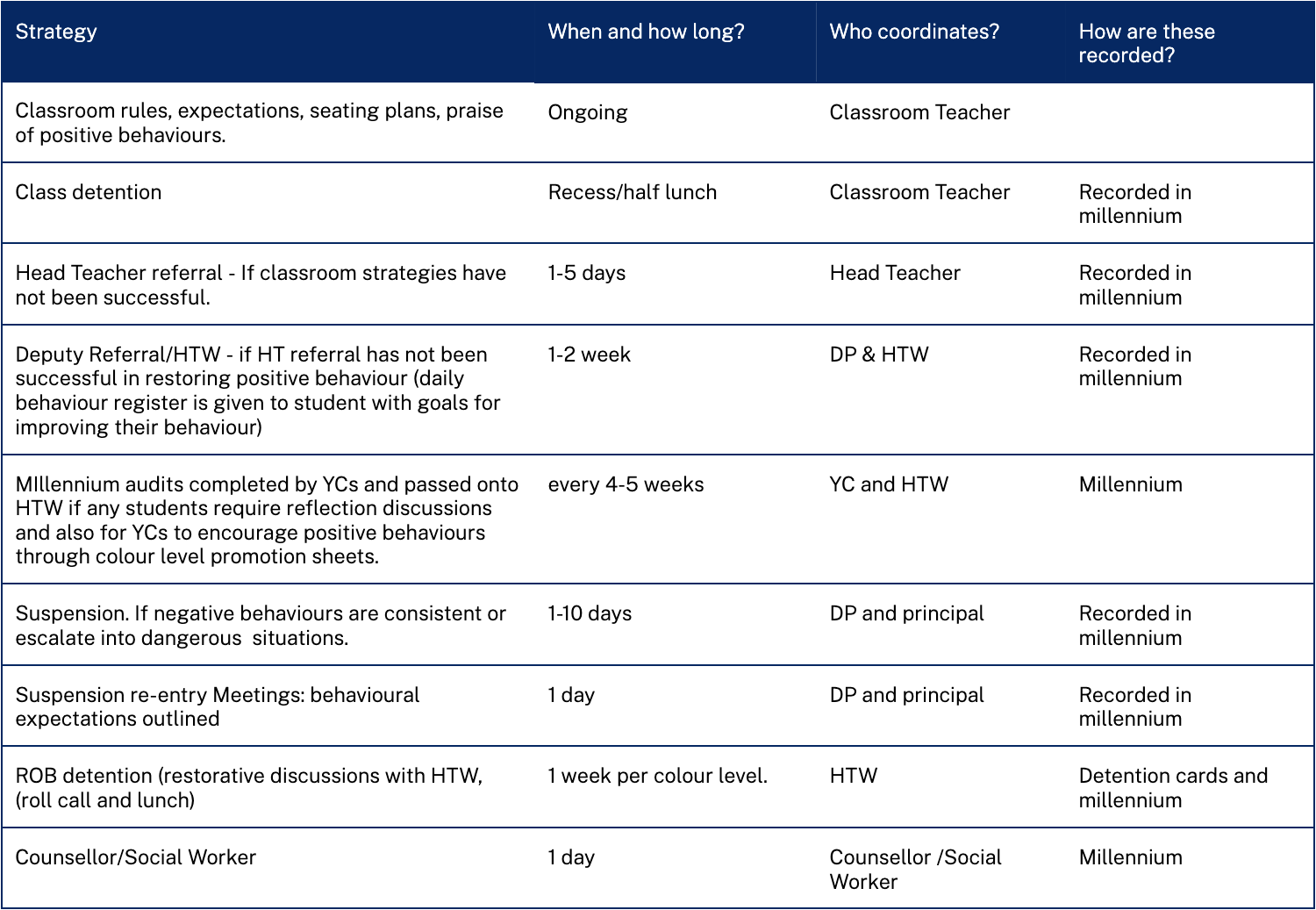
Farrer uses a variety of strategies to support students in reflecting on their behaviour and repairing relationships. These practices are designed to be age-appropriate and ensure the wellbeing of the student, including regular food and toilet breaks as needed.
Review dates
Last review date: Day 1, Term 1, 2025
Next review date: Day 1, Term 1, 2026